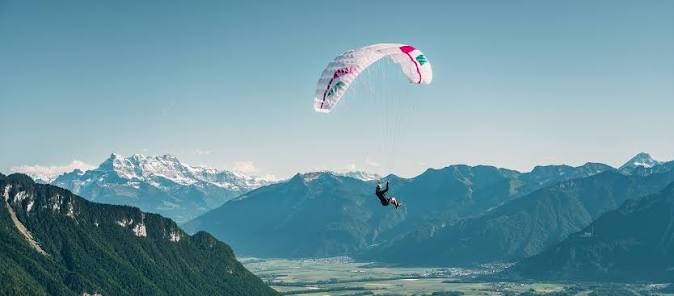
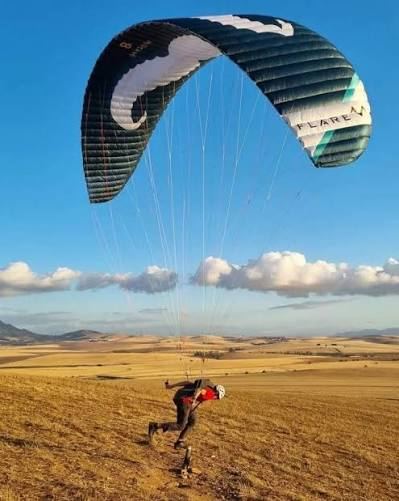
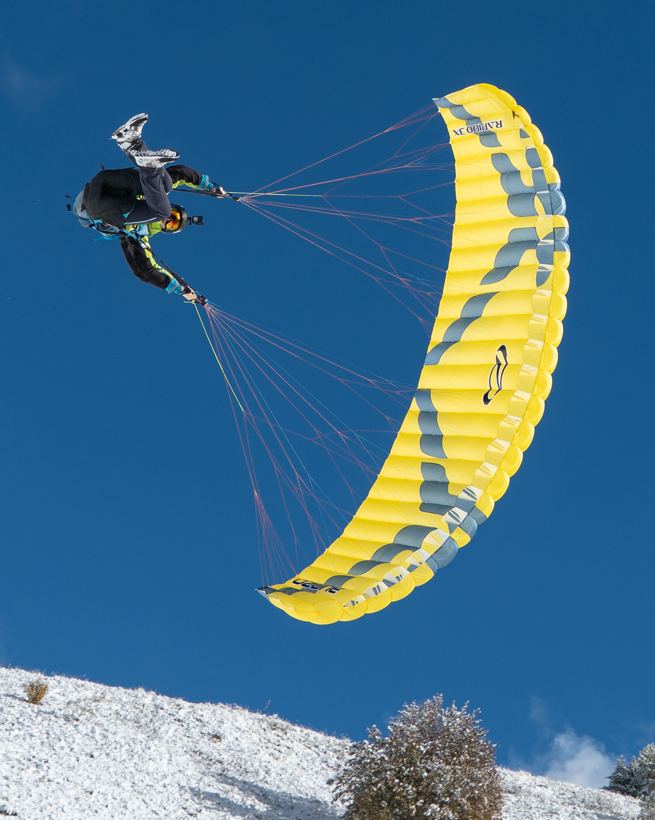
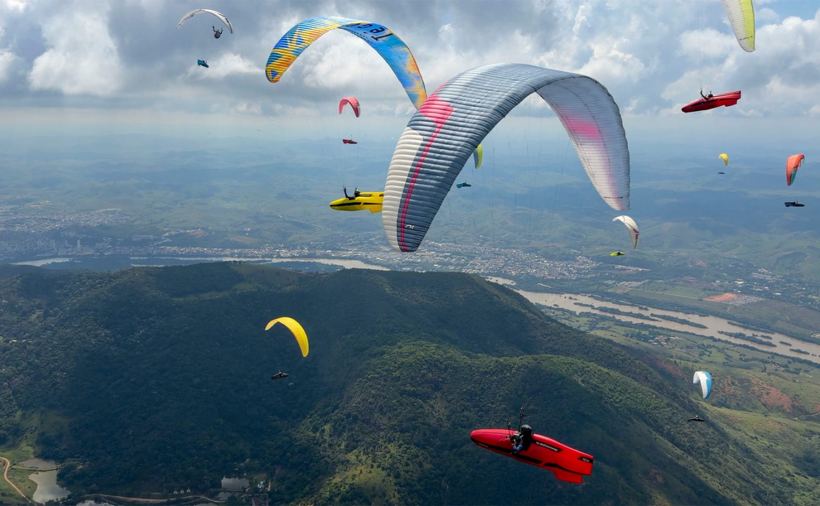
The first module of the course “Small wings”. How a mini wing and a speed wing differ from a paraglider, what speed flying and speed riding are, who can start them and when in our school in Gudauri, how we fly, what to bring and how much the training costs.
In shortThere are three wings: paraglider, mini wing and speed wing. And two ways to fly a small wing: speed flying (foot launch) and speed riding (on skis). The smaller the wing, the faster it is and the less it forgives mistakes near the ground. That is why in our school you move to small wings step by step, not all at once.
There is no single definition in the world. Federations and manufacturers divide wings by area, aspect ratioithe wing span squared, divided by the area. Simply: how long and narrow the wing is. Example: a sports paraglider has about 7, a speed wing about 3.5. and purpose. The border is not fixed: the same wing behaves like a mini wing with a light pilot and like a speed wing with a heavy one.
Paraglider
Mini wing
Speed wing
Area (flat)
20–30 m²
13–20 m²
6–15 m²
Aspect ratioithe wing span squared, divided by the area. Simply: how long and narrow the wing is. Example: a sports paraglider has about 7, a speed wing about 3.5.
5 or more
4.2–4.8
3.0–3.9
Glide ratioihow many metres the wing flies forward for 1 metre of height lost in calm air. Glide ratio 8: from 100 m height you fly 800 m.
8–11
7–8.5
3–6
Wing loadingithe flight weight of the pilot with all gear, divided by the wing area, kg/m². More loading: faster flight.
3.3–4.5 kg/m²
4–7 kg/m²
5–15 kg/m²
Trimmersistraps on the risers that change the angle of the wing. Released: the wing is faster and goes down more steeply. Pulled in: slower.
usually none
often
always, long
Does it soar?
yes
yes, in steady wind by the slope
hardly
Certificationia European standard. Part 1 tests strength, part 2 tests behaviour in flight and gives a class A–D.
flight test EN 926-2, classes A–D
some sizes EN B, C or D
strength only, EN 926-1
What for
cross-country, soaring
descent from the mountain, hike & fly, a little soaring by the slope
fast descent along the slope
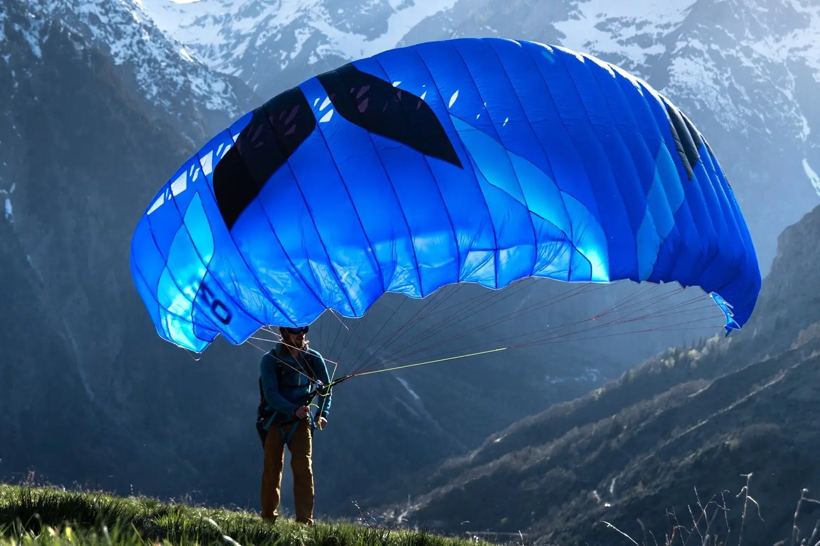
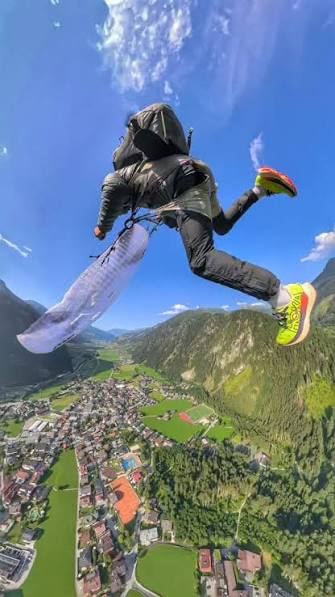
Paraglider: a long wing, it soars and flies farMini wing: smaller and shorter, descends from the mountain, soars a little by the slopeSpeed wing: short and wide, fast descent along the slope
Real-life example: a paraglider is like a sailing boat, it wants to sail far. A speed wing is like a sledge on a steep hill: it goes fast and down, and does not go far forward.
A big, long wing: area 20–30 m², aspect ratio 5 or more, glide ratio 8–11. For every metre of height it flies 8–11 metres forward.
In practice
From the same launch, a paraglider flies far away from the slope and can soar for hours.
Mini wing
What it is
Smaller and shorter: 13–20 m², aspect ratio 4.2–4.8, glide ratio 7–8.5. It often has trimmers.
In practice
It descends from the mountain calmly; in steady wind it can soar a little by the slope. A good first small wing.
Speed wing
What it is
Short and wide: 6–15 m², aspect ratio 3.0–3.9, glide ratio 3–6, long trimmers. No flight certification, only a strength test.
In practice
It flies along the slope, fast and steeply down. A mistake near the ground costs more, so you reach it step by step.
Three wings from one launch
What it is
The smaller the area and aspect ratio, the steeper the descent line and the higher the speed.
In practice
The paraglider flies out into the valley, the mini wing descends to the foot of the slope, the speed wing follows the slope.
Wing area and aspect ratio in the top view are to scale (24, 16 and 11 m²; aspect ratio 5.5, 4.5 and 3.4). Descent lines are sloped by glide ratio 9, 7.5 and 4; the slope is about 1 : 3.5. Terrain and heights are schematic. Figures: the school's speed knowledge base, manufacturers' pages.
How a speed wing differs from a mini wing
The main difference is in the design: a speed wing has a low aspect ratio and long trimmers.
A low aspect ratio means the wing is short and wide. It is more resistant to collapses, but it glides worse: for each metre of height it flies a shorter distance.
Long trimmers let you change the speed and the descent angle a lot. You release the trimmers: the wing speeds up and goes down more steeply.
Real-life example: look at the two wings below. A sports paraglider has a long, narrow wing, aspect ratio about 7: it flies far and loses height slowly. A speed wing is short and wide, about 3.5: it goes down faster, but it is more stable and turns more sharply.
Sports paragliders: long, narrow wings, high aspect ratioSpeed wing: short and wide, low aspect ratio
A mini wing is closer to a paraglider: it is longer, glides better, and in steady wind it can soar a little by the slope.
Why a small wing is faster: wing loading
Wing loadingithe flight weight of the pilot with all gear, divided by the wing area, kg/m². More loading: faster flight. = the whole flight weight (pilot, clothing, harness, wing) divided by the wing area. In the school we use the flat area.
Real-life example. A pilot weighs 75 kg, with gear 85 kg.
Paraglider 24 m²: 85 / 24 = 3.5 kg/m². It can soar for hours.
Mini wing 16 m²: 85 / 16 = 5.3 kg/m². It descends from the mountain calmly and soars a little by the slope.
Speed wing 11 m²: 85 / 11 = 7.7 kg/m². A fast descent along the terrain, a mistake near the ground costs more.
A paraglider has the EN 926-2 flight tests: two pilots test collapses, stalls, the spiral, launch and landing, and the wing gets class A, B, C or D. The lower the class, the more the wing forgives mistakes.
Speed wings do not go through these tests. They only have the EN 926-1 strength test: the wing will not tear, but the test says nothing about behaviour in flight. The reasons are simple: if the minimum speed is above 30 km/h, the standard gives class D straight away, and on a loaded speed wing it is almost always higher; also, with released trimmers the wing behaves differently than in the tests. Mini wings vary: large sizes often have class EN B or C, small ones only the strength test.
What this means for you: there is no “beginner” class for speed wings, like EN A for paragliders. So the choice of a wing rests on three supports: area, wing loading and the manufacturer's advice on pilot level. This is fixed in the school steps (module 2).
Speed flying and speed riding
Speed flying is not a type of wing but a way of flying: a foot launch and a fast descent on a mini or speed wing close to the slope. In our school in Gudauri (Georgia) the season for speed flying and mini wings is from 1 May to 30 November.
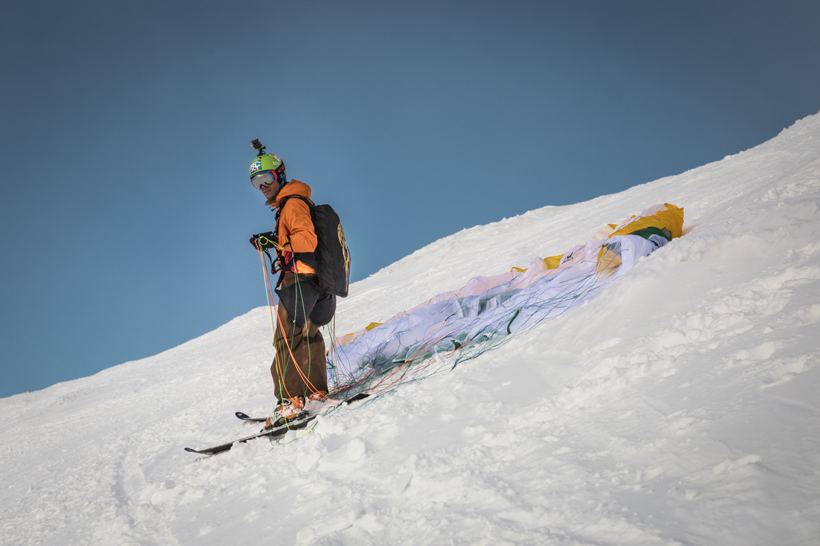
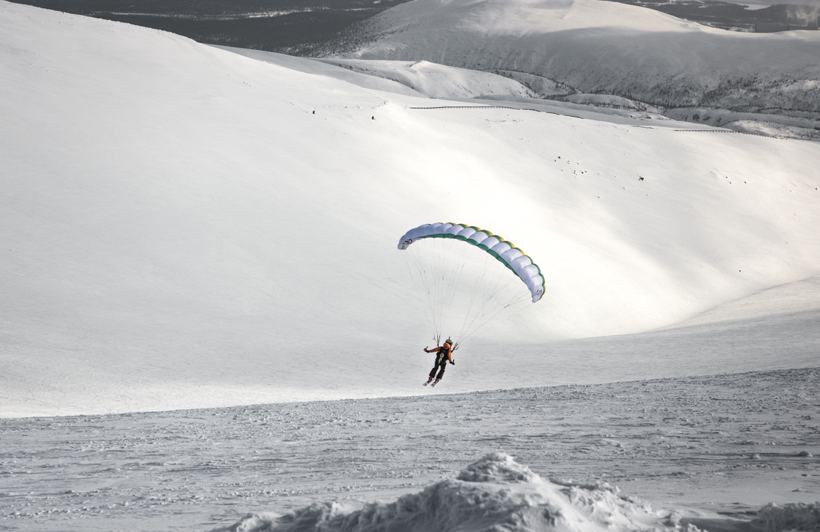
Speed riding is the same wing, but on skis: a descent where skiing and flying alternate, with touches on the snow. The school season in Gudauri is from 5 December to 15 April. Skis only: the programme and the launch are made for skis, we do not take snowboarders.
Speed flying: foot launch, descent along the slopeSpeed riding: laying out the wing on the snow before launchSpeed riding: flying and touching the snow on skis
Descents on a speed wing do not count as paragliding flights. They are logged separately in the pilot logbook.
Speed courses run in the same months as paragliding, but on other dates. The training areas are close, but they do not overlap.
Drag the diagram sideways to see all of it.
Season1 May to 30 NovemberLaunchon footGoing upon foot or by carWhereGudauri, GeorgiaSeason5 December to 15 AprilLaunchon skisGoing uplifts, ski passWhereGudauri, GeorgiaSummer, days214Winter, days132Breaks1–4 Dec and 16–30 Apr
Speed flying and mini wings
What it is
School season in Gudauri: 1 May to 30 November. Foot launch.
In practice
In summer it is mostly hike & fly: we walk up and come down on the wing. Where possible, we drive up by car.
Speed riding
What it is
School season in Gudauri: 5 December to 15 April. Skis only.
In practice
We go up by lift, so you need a ski pass. Everyone's first day starts with skiing.
All year
What it is
Two breaks: 1–4 December and 16–30 April. The rest of the time, one of the two seasons is on.
In practice
Speed courses run in the same months as paragliding, but on other dates. The training areas are close, but they do not overlap.
School seasons as set by the owner. Bars by day: bar length = number of days in the season. Between the seasons there are no small-wing courses.
Who can start, and when
Age: from 16.
Speed flying and mini wings open after the paragliding steps “Mountain flights on radio” and “Ridge soaring” and from 50 high flights. Why: on a small wing everything happens faster, so you need experience of launch, landing and reading the wind on a normal wing.
Speed riding you can start from zero if you ski well. Everyone's first day starts with skiing: the instructor checks your level. You ski confidently and sensibly: we move on to the wing. If not: first learn to ski and come back later. A paraglider pilot also does this ski day.
Step
What you can do
Condition
Speed flying and mini wings, level 1
flights with an instructor
mountain on radio + ridge soaring, from 50 high flights
Speed flying and mini wings, level 2
on your own
30 flights on a speed wing, 100 high flights on a paraglider, theory
Speed riding SR1–SR2
descents on radio with an instructor
ski test, 16+
Speed riding SR3
solo descent along the corridor
50 descents, theory
Speed riding SR4
stronger wind, landings out of a turn
150 descents, not earlier than 8 months after SR3, theory
Speed riding SR5
expert
350 descents, not earlier than 12 months after SR4, theory
You see the same steps in the pilot logbook.
How we fly: hike & fly
In summer we mostly do hike & flyiHike & fly: you walk up the mountain with the wing in your rucksack and come down on the wing. Example: you walked up the slope, came down on the wing in a few minutes and walked up again.: we walk up, come down on the wing, and walk up again. How many climbs per day depends on your fitness. Where possible, we drive up by car. In winter, for speed riding, we go up by lift.
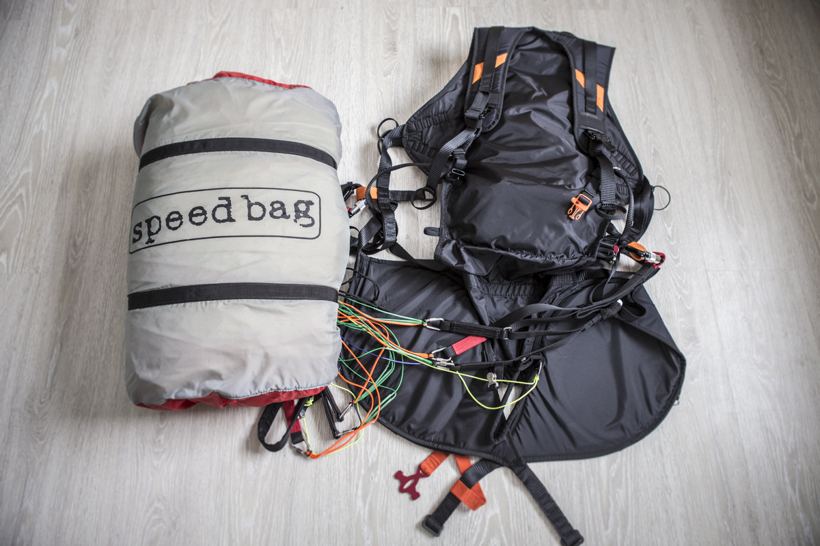
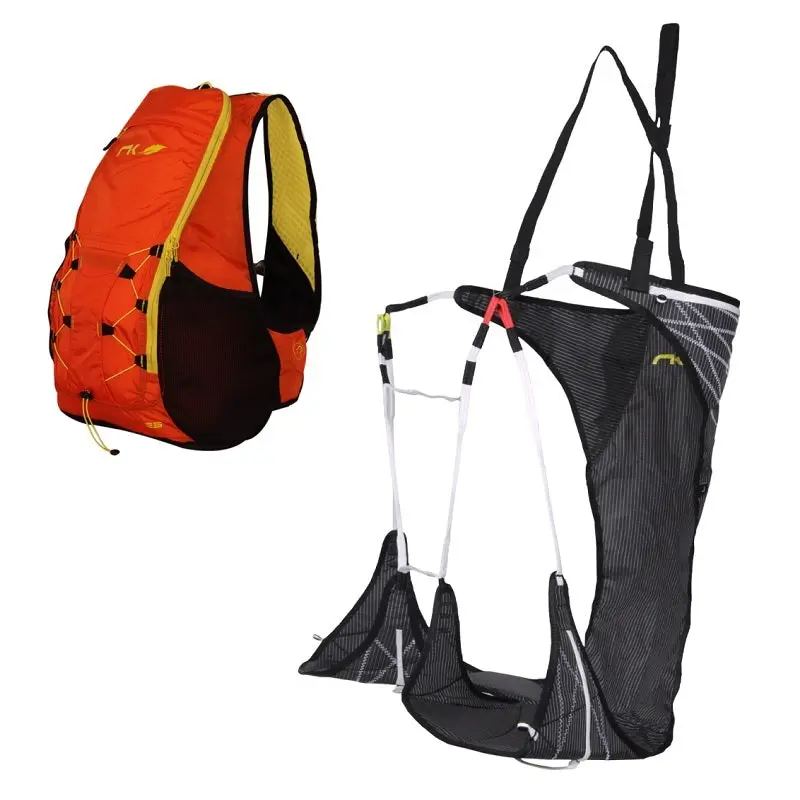
Light kit: wing in a bag and harnessRucksack and light harness for hike & fly
What to bring
Comfortable closed shoes that support the ankle (in winter, ski boots).
Good gloves.
For the first lessons, knee pads and elbow pads.
Speed riding: skis, avalanche shovel and probe. The school gives you the avalanche transceiver. You can rent the full set with a rucksack from us.
Willingness to walk uphill: in summer we walk up a lot.
On the course the school gives you the wing, harness, helmet, back protection, radio, and for speed riding also the avalanche transceiver. You can order your own wing and harness through us: we are dealers of speed wings and mini wings and will choose the size for your step. In Georgia, with customs clearance, a normal set (wing and harness) costs about 2900–3700 €.
What it costs
Course
Group 3+, per person
Two people, per person
One person
Speed riding, 5 December to 15 April
1 day
200 €
300 €
600 €
5 days (SR1–SR2)
800 €
1200 €
2400 €
10 days (up to SR3)
1550 €
2325 €
4650 €
Extra day
160 €
240 €
480 €
Speed flying and mini wings, 1 May to 30 November
1 day
200 €
300 €
600 €
3 days
650 €
975 €
1950 €
6 days
1100 €
1650 €
3300 €
Extra day
180 €
270 €
540 €
Our groups are from 3 people. Two people split the price for one person in half. One person pays as much as three, but gets all of the instructor's attention.
The price includes: wing, harness, helmet, back protection, radio, and for speed riding the avalanche transceiver. Not included: ski pass (about 70 GEL per day), skis, shovel and probe, insurance, accommodation (hostel from 25 €, apartments from 70 € per night), food (60–100 GEL per day), transfer.
Example: speed riding for 10 days in a group, a hostel, a ski pass and food at 100 GEL per day come to about 2380 €.
Any questions about training: write to us, we will answer.
How this course works
A common part for everyone: 9 modules (wing and loading, trimmers and speed, weather, terrain, mistakes near the ground, decisions and psychology, equipment, how they teach around the world).
Block “Mini wing and speed flying”.
Block “Speed riding” (with an avalanche module).
Two exams: “Speed flying and mini wings” and “Speed riding”. 50 questions, pass mark 80%, that is no more than 10 mistakes. You can practise on all the questions by module.
---
Practice and the next modules are for our students
This module is open to everyone. The question practice, the next modules and the exams are open to those who train with us. Access to the theory is included in the course fee: it runs for the whole course and for three months after it ends.
If you are training with us now, or have trained with us before, sign in with your access code. If you are a pilot from another school, access can be bought separately.